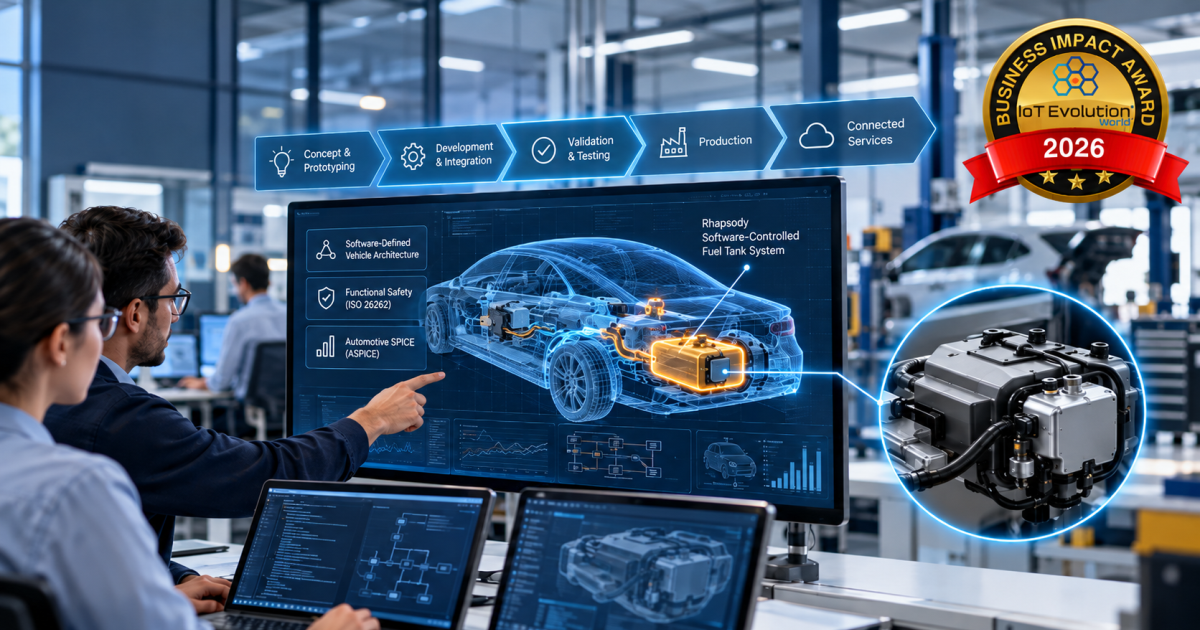
An end-to-end engineering framework gave the automotive supplier traceability, automated validation and a reusable path from mechanical products to software-enabled systems.
When automotive differentiation moves into software
For established automotive suppliers, the transition to software-defined products is not a matter of adding an app. It requires new engineering skills, safety processes, development tools, and validation disciplines that can stand up inside a production vehicle.
Kautex, a German company ranked among the world’s top 100 automotive suppliers, faced that challenge as it sought to digitalize mechanical products for safe, sustainable mobility. One priority was Rhapsody, a software-controlled fuel tank system designed to minimize evaporative emissions through precise control of fuel valves. Bringing it to market required production-ready software compliant with ISO 26262 functional safety expectations and Automotive SPICE (ASPICE), development practices.
The engagement sits within the customer work highlighted by TCS DriveSphere, the company’s mobility engineering portfolio. DriveSphere spans the vehicle lifecycle from concept and prototyping through production and after sales, bringing together connected services, electrification, cockpit systems, body and chassis software, software-defined vehicle architecture, and multi-level validation. TCS supports that portfolio with more than 55 global labs and prototyping facilities.
Building a capability, not just delivering code
TCS and Kautex began with a joint workshop to understand the supplier’s product and engineering ecosystem. They then established an in-house software organization, defined development scope, and created the toolchain and agile environment needed to execute. Application lifecycle management, DevOps, and continuous integration gave the program a common operational backbone.
On the engineering side, TCS developed model-based applications and basic software while supporting requirements analysis, architecture, development, integration, verification, and validation. Testing operated at model-in-the-loop, software-in-the-loop, and hardware-in-the-loop levels. Hardware design, functional safety, and ASPICE process support completed the end-to-end framework.
That architecture matters because safety-critical automotive software must preserve the thread from requirement to implementation and test evidence. A change cannot disappear into an informal handoff. Kautex needed both a product outcome and a governed development system that could be audited, repeated, and extended.
TCS says the resulting automated validation framework reduced testing effort by 50 percent across all software-test levels and achieved 100 percent development traceability. Kautex reached ASPICE Level 1 within one year, and the software rollout continued with zero delays during the COVID-19 pandemic. The framework was also being replicated in other Kautex product lines.
Generative AI extends the validation story
DriveSphere’s broader significance is visible in how TCS is now applying generative AI to automotive testing. In a separate capability described by NVIDIA, TCS’s Automotive Gen-AI Suite generates unit-level test cases from unstructured requirements using a fine-tuned Llama 3 8B Instruct model, retrieval-augmented context and post-processing. Training and inference remain offline to protect sensitive customer data, with deployment on on-premises NVIDIA DGX H100 systems through NVIDIA NIM microservices.
TCS reported roughly doubling its overall test-case-generation pipeline speed, while NIM-based inference ran about 2.5 to three times faster than other open-source direct-inference scenarios at similar accuracy. Evaluation included accuracy, decision coverage, condition coverage, and modified condition/decision coverage.
While these are TCS pipeline results, not outcomes from the Kautex deployment, as supporting context, they show how the same validation bottleneck addressed through automation at Kautex is becoming a target for secure, specialized generative AI.
Why DriveSphere merits Business Impact recognition
The Kautex work demonstrates business impact at the level where automotive transformation often succeeds or stalls: organizational capability. TCS helped create the team structure, lifecycle controls, toolchain and validation framework needed to move from hardware-centric engineering toward software-enabled products.
DriveSphere’s award recognition is supported by outcomes that are both technical and managerial. Lower validation effort can improve development economics. Full traceability supports safety, quality and audit readiness. Achieving ASPICE Level 1 within a year provides a standards-based marker of maturity, while replication offers leverage beyond one program.
Connected and software-defined vehicles depend on disciplined engineering long before their telemetry reaches the cloud. That foundation becomes more important as vehicles add code, connected services and continuously evolving functions. By pairing reusable development infrastructure with advanced validation methods, TCS DriveSphere shows how an IoT-era mobility platform can translate software ambition into production capability.
Edited by
Erik Linask