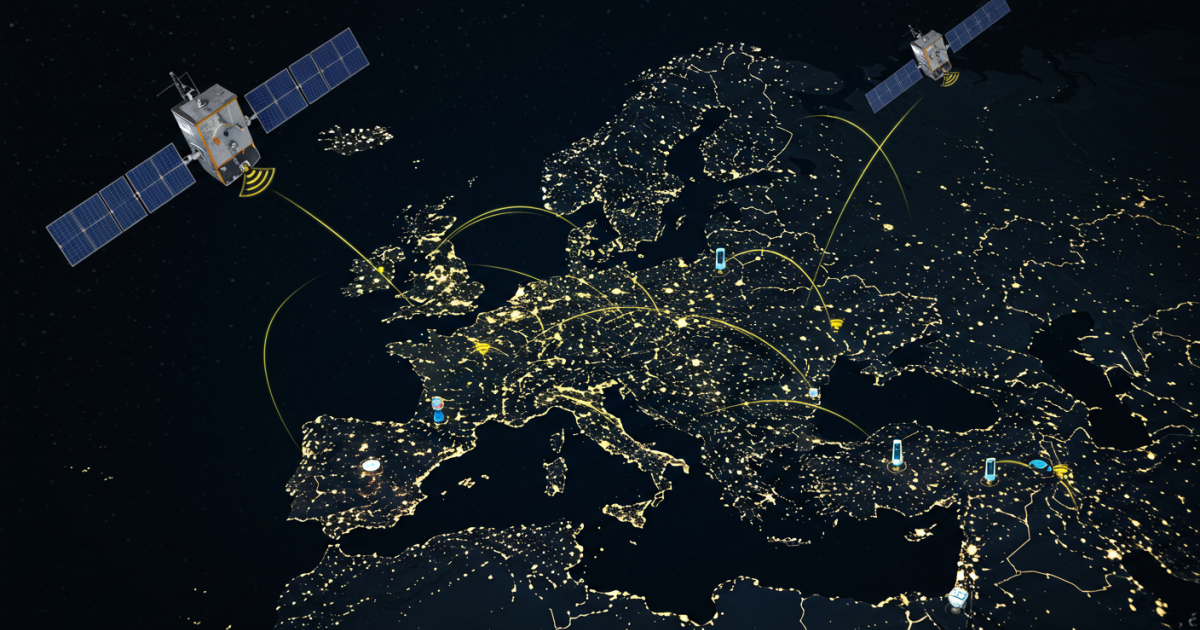
While the recent embrace of Russia by the U.S. has not been well received by the Europe Union, there has been a divergence of paths for quite some time. Our friend Harald Naumann, at Antennity explored (in a post on LinkedIn) where we stand currently how the EU is moving forward independent of U.S. technology.
It should be noted that Ukraine is seen as the first domino to fall, but the view in the U.S. is that Russia would like to restore the entire USSR and, perhaps, additional parts of the Eastern Block.
So, recent blocking of Ukraine’s access to satellite imagery by the U.S. government has blinded Ukraine’s intelligence. It is believed that satellite imagery is still available from Maxar Technologies on a commercial license, and there is no sign of the curtailing of any Internet traffic coming out of Ukraine.
However, there is an Open-Source Intelligence (OSINT) community in Ukraine that relied on the satellite imagery from the U.S. government to do its analysis. In addition to the restriction on imagery is the threat to shut down Starlink.
All of this leads to a desire to eliminate the risk of U.S. dependence, including a concern that the U.S. will assist Russia. This has led to a distrust in using U.S. protocols.
For example, satellite use of Long Range-Frequency Hopping Spread Spectrum (LR-FHSS), which is an advanced modulation technique developed to enhance the performance of Low Power Wide Area Networks (LPWANs), particularly within the LoRaWAN® ecosystem is a target for elimination.
To eliminate these sole-sourced U.S.-based solutions, the EU is promoting MIOTY as an alternative to LoRaWAN. It will be interesting to see this play out, since EU MNOs were some of the first to adopt LoRaWAN and still represent a significant amount of the traffic.
In Germany, specifically, a critical infrastructure organization known as KRITIS is recommending the use of MIOTY as well as EU standard open alternative IoT protocols, such as DECT-2020 NR (ETSI), wM-Bus , and TS-UNBas.
In addition, EchoStar has licensing conditions for 2027, where it will only be allowed to carry EU radio protocols. If the restriction is not followed, the EU may end the relationship with EchoStar and advocate for the LEO/MEOs and the IRIS2 satellite. Efforts are underway to dedicated bandwidth for the Ukrainian military.
Along with the service independence is an effort for chip autonomy and to have semiconductors, like STM, NXP, and Infineon, only support EU protocols. The EU is looking to support open-source hardware projects, such as RISC-V-based IoT modules.
Politically, the EU is bracing for U.S. sanctions and developing ways to support EU companies. The EU is also filing a WTO complaint, challenging U.S. tariffs and technology blockades as discriminatory against European CRITIS regulation.
If you read me often, you know that I am genuinely concerned about the future of the world supply chain. As we move to this “new world order” the change to the supply chain and, in particular, the role of the U.S. Navy, may change significantly. Based on the uncertainty that already exists, insurance on containers has risen significantly (10-15%) in recent years.
While I believe this risk opens global supply chain to more IoT solutions, I think the focus will be elsewhere, particularly until the “new world order” becomes the status quo.
Edited by
Erik Linask