If you don’t know about Transforma Insights, you should make it a point to connect with them. I find Jim and Matt to be well connected and to see the future pretty clearly. Their insight is a partial reason behind our expanded focus on AIoT.
As more IoT devices expand their capabilities to support AIoT, we should expect to see new categories of applications.
AIoT is a blend of AI and IoT but, as a blend, the mix is not an easy one, particularly when you consider the incredible pace of AI compared to IoT’s emphasis on long life cycles, especially for remote deployments.
“Artificial Intelligence (AI) and the Internet of Things (IoT) are two of today’s most impactful technology developments. Inevitably, an increasing range of both enterprise and consumer applications and solutions leverage both technologies. A growing subset of these applications and solutions incorporate AI capabilities directly onboard an IoT device, as AIoT, unlocking benefits ranging from faster response times to more efficient use of connectivity bandwidth.”
“A new kind of platform will be needed to support AIoT. Any platform intended to support AIoT connections must effectively combine capabilities from both AI and IoT platform domains… In a new report, 'A new kind of software platform for AIoT?,' Transforma Insights identifies the software platform functions that will be required to support AIoT, including the need to compress AI models for deployment on AIoT devices, the management of AIoT in the field, and contextual considerations and future requirements.”
The full range of aspects considered is highlighted below.
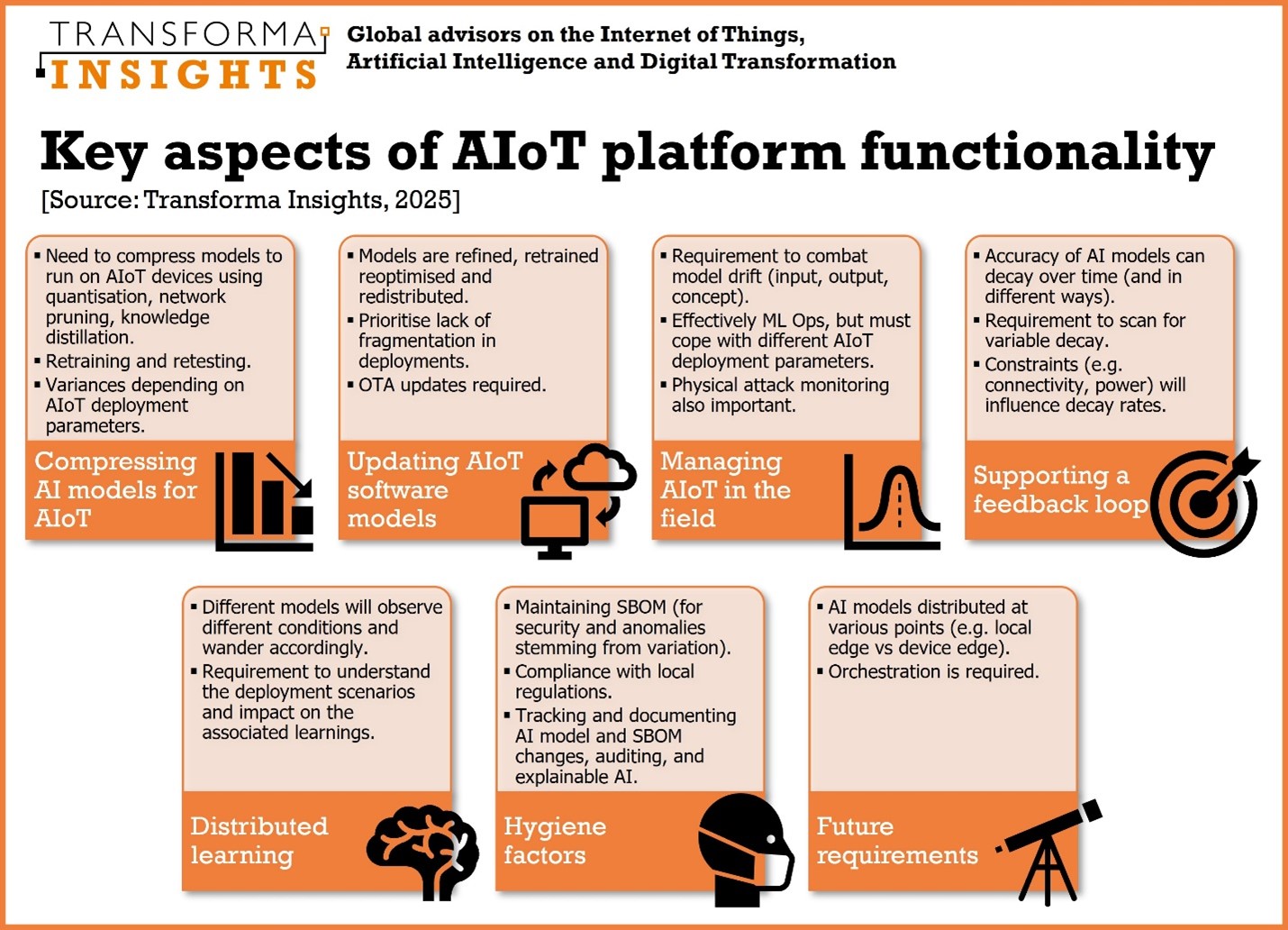
What the table shows is how the considerations of AI impact the architecture and deployment strategies.
- Compressing AI models for AIoT: The goal in IoT is to collect relevant data and not to track every aspect of a device. Therefore, the scope of the language set is confined to a “must” rather than an “all” information gathered.
- Updating AIoT software models: AI’s ability to innovate particularly as devices are empowered with autonomy needs to have uniformity in the deployments or the structure of information will be inconsistently processed. This is particularly important as new revisions and upgrades have to be universally deployed.
- Managing AIoT in the field: We have already talked about managing revisions, but there are other issues around security and required data sets.
- Supporting a feedback loop: AI is likely to be constrained by power and connectivity, leading to data decay. The result being that monitoring the monitor becomes as vital as the information being gathered.
- Distributed learning: The combination of AI and IoT adds a layer of complexity to where information is processed and the possible refinement of data throughout the network of devices, edge processors and the cloud. Ensuring learning does not vary based on architecture needs to be prioritized.
- Hygiene factors: Dealing with security and anomalies needs to be well understood and distributed to the network resources consistently. In addition, local compliance issues and deviations in the SBOM need to be documented.
- Future requirements: The blending of AI with IoT changes the opportunity to update the remote systems like never before. As such it should be expected that updates will be requested and managed systematically.
Jim Morrish, a founding partner at Transforma Insights comments: “Many of the required functions already exist but not yet optimised for AIoT. Supporting software platforms for IoT are relatively well-developed and supporting software platforms for AI are developing quickly. Accordingly, many of the capabilities required to support AIoT devices can already be identified in one, or other, of these domains. However, existing IoT platform capabilities have generally not yet been optimised to support distributed AI software, and AI software platforms generally do not take into account the full range of constraints of IoT environments.”
Morrish continued: “New capabilities will, however, be required. For example, support for the optimisation of AIoT models to take into account the cost and performance parameters of available connectivity and power drain in the case of battery powered (or energy harvesting) devices. Additionally, any condition and performance reporting from an AIoT device will be constrained by these same factors.”
The report is available to Transforma Insights subscribers here. Further analysis of the AIoT opportunity including ultra-granular forecasts for AIoT can be found on Transforma Insights’ website.
Edited by
Erik Linask