Note: I asked AI to help me with this article; it turns out I had issues with pretty much everything it came up with. So, I thought it would be a good exercise to address my issues – and then you can email me your opinions.
The text from AI is in bold, followed in each case by my comments.
IoT’s future is no longer about just connecting “things”–it’s about empowering business results.
My personal belief is the statement above is for laggards because the cloud companies, like a mermaid, promise safe passage without having to worry about the last mile. The reality is that many MSPs and MVNOs have found workarounds, so it is rare that a customer gets caught between “a rock and a hard place.”
Companies worldwide are shifting to platforms and service-oriented revenue streams.
I take issue with this line because most IoT companies focused on “service-oriented” revenue more than three years ago. They went into vertical markets and looked to expand their services to match the additional needs within a vertical.
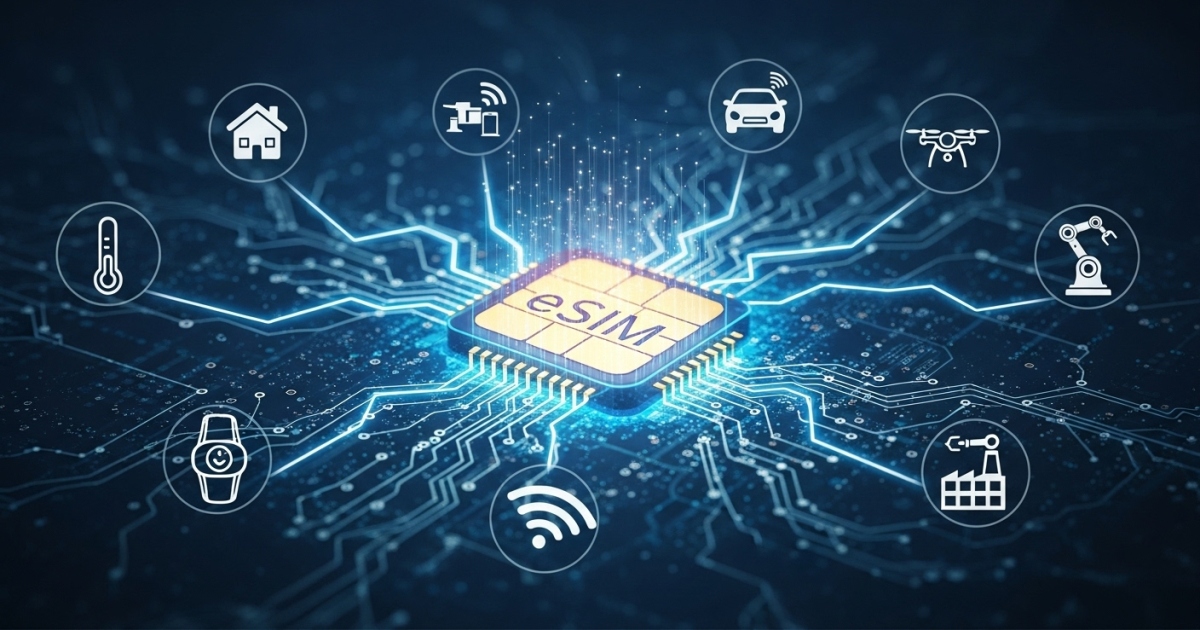
The rapid adoption of eSIM technology and unified marketplaces are igniting this transformation, making connectivity programmable and deployments dramatically simpler.
Yes, this is happening, but it has minor impact on service-oriented revenue streams, except for a few companies that are focused on connectivity management – for example Eseye, floLIVE, and Simetric.
Why eSIM and Marketplaces Matter
Managing countless devices across diverse regions has long been a pain point. eSIM technology lets devices switch carriers on the fly, so businesses can avoid the complexity of physical SIM management and renegotiating contracts for each market. The result: connectivity becomes software—scalable, flexible, and instantly global.
No disagreement here.
Marketplaces, meanwhile, centralize the purchasing of connectivity, analytics, and device management. Think of it as the “app store effect” for IoT: enterprises can onboard, integrate, and launch new solutions faster, with less overhead and risk.
I could be wrong, but I have not anyone talk about this, like a do-it-yourself solution or a service that should be considered the software equivalent of redundancy or failover. My discussion with the industry is that they offer the solution to customers, often bundled at no additional charge to win the business. Now, I would hope that the active eSIM profiles they have in standby are an upcharge, but that is still a connectivity charge IMHO.
The Subscription and Outcome Revolution
Instead of selling gadgets, vendors now deliver IoT as a subscription – charging for actual usage, data volume, or business results (like uptime or asset visibility). This aligns provider incentives with enterprise goals and creates predictable, steady revenue streams in a volatile economic climate.
Selling gadgets has not been a good strategy for this industry for a long time. The alignment is with customer vertical requirements and does bring the “provider” in line with “enterprise goals.”
Before we go any further, the title of this piece says it’s about “platforms.” I believe what they are talking about here is the single pane of glass (SPOG) ideal of managing all elements of connectivity from one console. The SPOG platform does improve the experience, but rarely reaches inside the data. In this way, they all resemble the MNOs managing connectivity and not data management.
The bottom line to me is that connectivity is still at the heart of the service. If a company focuses on rendering data analysis, then it is a different type of AIoT company. I will concede to AI that this new breed is happening, but I don’t see how eSIMs directly impact the application layer other than the AIoT application companies can act like the hyperscalers and assume connectivity is a given.
Market Proof: Explosive Growth
The global IoT platform market topped $16.11 billion in 2025, and projections show it soaring to $43.43 billion by 2033, a 13.2% CAGR – proof that service-based thinking is here to stay.
The number of connected IoT devices will reach 21.1 billion in 2025, doubling by 2030. eSIM-based devices – already on track to be 71% of cellular IoT connections by 2030 – make global deployment seamless.?
I won’t argue with the numbers, because I worked for an analyst company and have a different viewpoint but, for me to express that view would be a disservice to my former employer. I will say this, for many companies looking to tap the VC market, the bigger the number the better.
Remember bigger projections are not the same as better projections.
Democratization and Interoperability
These platform marketplaces level the playing field: small firms gain enterprise reach, while large corporations can pilot innovations rapidly. Open standards are bringing true interoperability, shrinking time-to-market and slashing costs.
I am having a tough time understanding the role of standards here, since a platform is primarily software, and APIs are great at forgiving the lack of standard formats, features, and cloud services after processing.
The Telco Pivot
Connectivity is becoming a utility, forcing telecoms to think beyond bandwidth. By offering integration, analytics, and lifecycle services, they can become strategic partners at the heart of IoT transformation – not mere pipe providers.
Hmmn, was this AI thinking that Telecoms (MNOs) represent the total market? Perhaps, then, it makes sense, as the MNOs are using SPOG solutions from third parties to render connectivity and allow the MNOs to avoid direct relationships. However, it’s still connectivity-based services.
While the focus on MNOs forgives some of the myopic thinking, vertical partnerships have been offered since the early days of telematics. I have not reached out to my telco friends in a while, but I am willing to believe they have grown closer to application platforms.
Security, Compliance, and Sustainability by Design
Centralized platforms improve security and compliance, giving business leaders holistic visibility and control, while also reducing the risks associated with device fragmentation. Sustainability benefits are baked-in, with remote management and analytics helping teams optimize energy use and reduce operational waste.
Wrong! Recent cloud outages are going to be the “cause célèbre,” and distributed redundant systems are going to be the rage for next year at least.
Conclusion
The combination of eSIM flexibility and platform interoperability means IoT can be delivered anywhere, instantly, and managed remotely, regardless of geography. The underlying value lies not just in connecting devices, but in connecting enterprises with meaningful business outcomes.
Right!
I do want to say that often, in trying to be relevant, words like “New and Improved,” “Next Generation,” “2.0”, “4.0”, and “5G/6G/7G” (depending on cellular or Wi-Fi) attract readers. Having hosted the Battle of the Platforms for a decade at our event, I feel that the past has been ignored and, if I did not inject my thoughts, I would not want my name on this article.
Edited by
Erik Linask