Occasionally, I either come up with something I believe is totally unique or something that was unique years ago and patented by someone else.
I am in that mode now, where I want to work on my patent claims, but I have to acknowledge my writing improves when I let AI rewrite me. But, what are the implications of letting AI rewrite my claims, particularly if I am using a free version of AI or an AI that does not promise privacy?
If, like me, you’ve found that AI tools sharpen your writing and speed your research, you’re not alone. But, when the stakes are patentable ideas, a natural question arises: Can using AI to draft, refine, or benchmark claims expose your invention or let someone else beat you to the filing? Is it possible that using AI to write your claim may void your claim?
Whether it’s just you or some co-authors, or a corporation with a legion working on filing for patents, it’s important to develop discipline to avoid leaking information. Keeping the information private is important.
How You Can Safely Use AI in a Patent Development Workflow
To be able to defend your authoring of a claim and protect your intellectual property you must establish and enforce strict privacy hygiene, keep humans as the inventors, and treat AI output as assistance in research, not inventive matter. This sounds easy but, when I use AI to rewrite my writing, it not only improves the clarity but enhances the argument. For today, the rules of patent authorship are that AI cannot claim authorship. Additionally, claims not supported by previous documentation of human authorship may be voided either in the filing or later if dealing with patent infringement (of others or by you).
As AI continues to improve at an amazing pace, you can find your intellectual property contaminated by AI unintentionally restating claims from previous patent filings. This matters because as public models intellec from broad interactions; you don’t want your unpublished claims to become part of anyone’s training set. In addition, patent novelty and inventorship rules are tightening around AI; human contribution must be clear and documented.
Below is a practical guide that keeps you both fast and safe.
You should start with a well-stated and adhered to Guideline regarding AI and intellectual property and limiting risks.
Here are the risks and how to avoid entanglements.
Guidelines Regarding AI and Intellectual Property
Data exposure and leakage:
Risk: Pasting claims into public chatbots can expose proprietary details through logging, human review, or future model training.
Controls:
1.1. Use enterprise versions with data isolation and no-training guarantees.
Disable chat history/logging where supported.
1.2. Prefer on-prem or private cloud LLMs for claim drafting and benchmarking.
1.3. Redact core inventive elements (numbers, parameters, sequences) when using public tools for style-only edits.
2.0 IP contamination and unintentional incorporation:
Risk: AI may echo prior patented language or combine known art in ways that muddy inventorship or novelty.
Controls:
2.1. Treat AI output as a lead for prior art search, not as claim text.
2.2. Run every AI-suggested element through a prior art sweep.
2.3. Keep a lab notebook: document human conception, reduction to practice, and how AI was used (editing, summarization, formatting).
3.0 Black-box explainability
Risk: If a claim limitation originated from AI, you may struggle to prove human conception.
Controls:
3.1. Ensure humans originate the inventive step. Use AI only for drafting quality, not for technical novelty.
3.2. Preserve version history showing human-to-human evolution of claims.
4.0 Timing and disclosure
Risk: Any public posting, conference talk, or AI platform with public sharing enabled can count as a public disclosure and start the clock (or destroy foreign rights).
Controls:
4.1. File a provisional application before any public exposure.
4.2. Mark all AI workspaces as private; avoid collaborative spaces without NDAs.
5.0 How private is “private” with AI?
Risk: Public chatbots: Assume anything you input could be stored and, in some cases, used for model improvement.Controls:
5.1. Avoid entering unpublished claim specifics.
Risk: Enterprise AI:
Controls:
5.2. Look for contractual no-training guarantees, SOC 2/ISO 27001, encryption at rest/in transit, SSO, audit logs, region pinning, and data retention controls.
Risk: Self-hosted models:
Controls:
5.3. Ensure your devops posture includes VPC isolation, key management, and role-based access.
5.4. Establish Safe workflow for patent drafting with AI
Searching for Prior Art
There are several applications and tools designed to help scour intellectual property (IP) and avoid patent infringement. These tools can assist in various aspects, including IP management, patent searching, and monitoring. Here's a breakdown of some useful applications:
Applications for Securing Intellectual Property
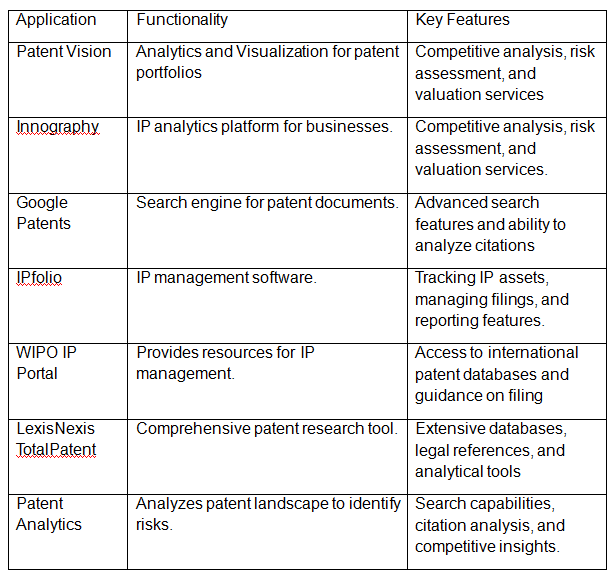
Most of these tools do some of these four categories, but it is probably worthwhile to make sure you are covered with these four categories.
- Search and Analysis: The ability to perform thorough searches to identify existing patents and avoid infringement.
- Monitoring: Tools that provide alerts for new patents in your area of interest.
- Collaboration Tools: Features that allow teams to work together effectively on IP management.
- Compliance and Reporting: Assistance in ensuring compliance with IP laws and regulations, along with reporting functionalities for stakeholders.
Conclusion:
When I started on this line of research, I was asking the question, “Do I have to worry about using AI as a way to steal a patent?” It turned out to be a much richer conversation, so I turned it into three articles. If you haven’t already, I recommend you read USPTO on Patents and AI next.
Edited by
Erik Linask