It’s 2025, y’all. If you’re at all like me, a new year means consciously flipping a mental switch so I’m not dating documents with “2024” on autopilot. (Same goes for casually saying “last year” rather than “[earlier] this year” and what have you.) These are minor tweaks, but it still feels easy to trip up.
That said, let’s kick this off on the right note:
Last year, we featured Ceva Inc. several times here on IoT Evolution World and over on our Industrial IoT News hub. Ceva, for any readers unfamiliar, provides smart edge and wireless connectivity-focused solutions. The Ceva team brings great expertise and passion to the table via its comprehensive (and scalable) technologies, “delivering differentiated solutions that combine outstanding performance at ultra-low power within a very small silicon footprint,” per the company.
Here’s a super-quick rundown of our Ceva-related coverage from 2024; if interested, click the links below for our full stories:
And to start the new year strong, Ceva dropped new news today:
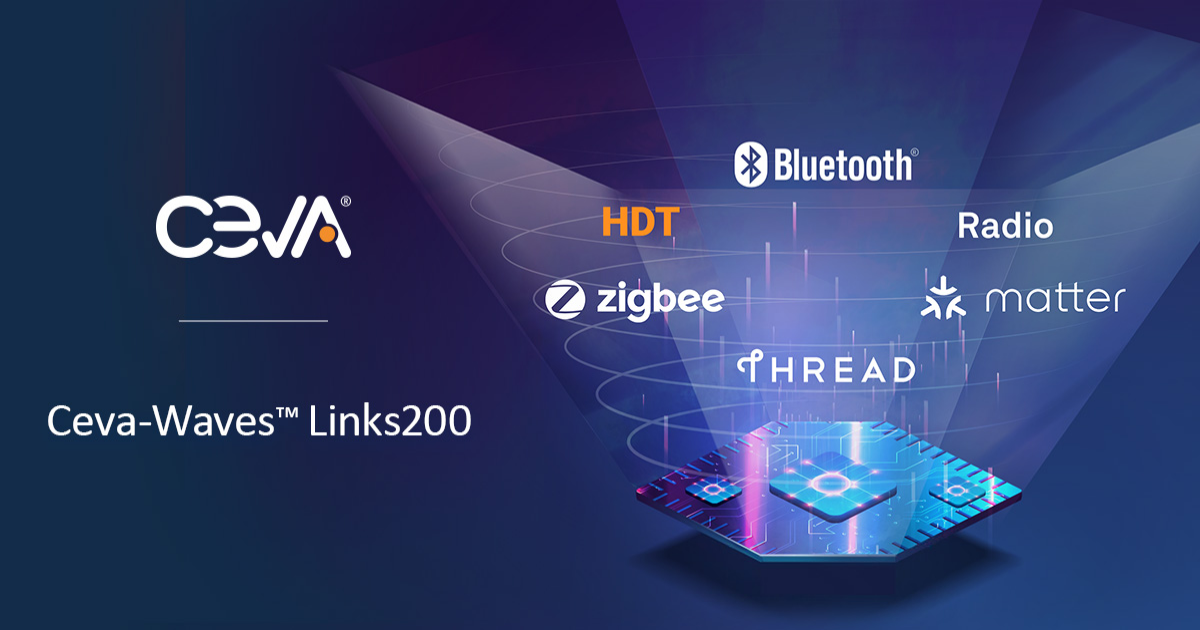
This morning, Ceva unveiled the Ceva-Waves Links200, the first complete turnkey multi-protocol platform IP to support next-gen Bluetooth High Data Throughput (HDT) alongside IEEE 802.15.4 for Zigbee, Thread and Matter.
“Addressing the rising market demand for faster, more efficient Bluetooth connectivity, particularly for low-power audio and latency-sensitive IoT applications,” Ceva wrote in the official announcement, “the breakthrough HDT mode more than doubles the speed of traditional Bluetooth, delivering a data rate of up to 7.5 Mbps. For this higher speed, Links200 employs innovative HDT modulation schemes in conjunction with Ceva’s state-of-the-art radio on TSMC’s 12nm FinFET process to satisfy the stringent performance demands in a low-power solution.”
“This leap forward in Bluetooth enables lossless, multi-channel, low-latency audio streaming for a broad range of devices,” Ceva added, “including TWS earbuds, headsets, smartwatches, smart speakers, TV wireless speakers, gaming peripherals, and car audio systems.”
Technical features also include:
- Full Bluetooth dual mode (Classic and LE) support, including next-gen HDT up to 7.5Mbps.
- Comprehensive Integration: Includes RF, modem, controller, software stacks, and profiles.
- Advanced Audio Support: Supports Classic Audio, LE Audio, and Auracast Broadcast Audio.
- Accurate and Secure Ranging: Supports Bluetooth Channel Sounding for precise and secure ranging.
- Optimized Process: Utilizes TSMC 12nm FFC+ process, ideal for advanced smart audio and Smart Edge AI SoCs.
- Superior Performance: Features best-in-class power consumption, die size and performance, with “state-of-the-art RF architecture” requiring minimal external components for low bill of materials.
- Ease of Integration: Put simply, it’s designed for fast time to market.
- Customizable for further product differentiation (i.e. tight integration with Ceva’s sensing and inference IPs, including Ceva-NeuPro-Nano NPU and Ceva-RealSpace Spatial Audio).
"The introduction of the Ceva-Waves Links200 multi-protocol platform with integrated RF technology underscores our commitment to breaking new ground in wireless connectivity and providing our customers with scalability and design efficiency to develop differentiated products that meet a range of market requirements," explained Tal Shalev, Vice President and General Manager of the Wireless IoT business unit at Ceva. "Developing Smart Edge SoCs is increasingly complex and expensive. By providing a 'drop-in' turnkey solution to support and combine multiple and the latest wireless protocols, our Links200 gives our IoT/AIoT customers the flexibility to customize their solutions and focus on innovation.”
Learn more here.
Edited by
Greg Tavarez