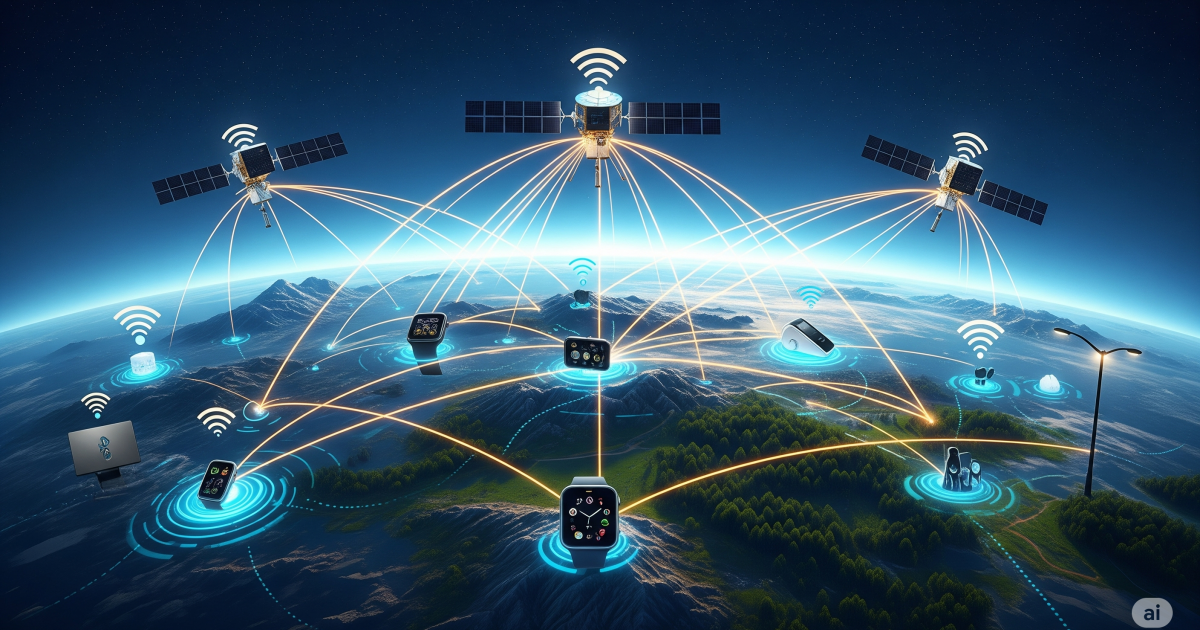
IoT has been going through tremendous change that makes and takes our full attention, which so few of us have anymore (“squirrel”). One specific area that deserves more attention is the use of Low Earth Orbit (LEO) to support what normally are considered short-range systems. Some of these systems, like Bluetooth, have big markets already. The question that remains is, how does the use of satellites change the dynamic?
To use a little historical perspective, let’s take a look at WiMAX.
We could say WIMAX was the precursor to 5G midband services. It was being adopted fairly quickly worldwide. When it started, WiMAX’s back-office capabilities were probably not scalable, but we learned from companies offering Wi-Fi that those weaknesses could be overcome. However, at the time, WiMAX was looking to continue the momentum and made the choice to be more of a carrier play than an enterprise play. That meant requiring a SIM card, forcing the enterprise to have a carrier involved with deployments. It also meant that a rebuild of edge devices was needed. The bottom line is that WiMAX was stalled, so demand dwindled, and carriers felt no rush to integrate WiMAX into their portfolios. Less than a year later, WiMAX was dead in the water.
Getting back present day, then, the question is, “Where can the inclusion of long-range capabilities change the OSS and how difficult is it for the LEOs to mask the underlying support systems?
The mutual benefit of LEOs and LoRaWAN
LEO satellites are revolutionizing the reach of LoRaWAN, enabling truly global IoT deployments. Here are some of the reasons LEOs are being adopted by the LoRaWAN community.
- Global Connectivity: LEO satellites provide a backbone for short-range networks, enabling global coverage where terrestrial infrastructure is absent or impractical (e.g., oceans, deserts, remote agricultural areas, disaster zones). This significantly expands the use cases for IoT devices relying on these networks.
- Low Latency: Compared to Geostationary Earth Orbit (GEO) satellites, LEOs orbit much closer to Earth, resulting in significantly lower latency. This is crucial for applications requiring near-time data transmission.
- Enhanced Reliability and Redundancy: With multiple LEO satellites passing over a given area throughout the day, the potential for continuous connectivity and redundancy is increased, making communication more robust.
- Cost Reduction (Long Term): While initial deployment costs for LEO constellations are high, the ability to connect a vast number of low-power, inexpensive devices over wide areas can lead to a lower overall cost per connected device in the long run.
- Challenges: Despite the advantages, LEO integration presents challenges. The high speed of LEO satellites can lead to significant Doppler effects, and resource optimization (energy efficiency, data extraction rate) for LoRa devices needs careful management due to the dynamic environment and increasing number of IoT terminals.
Likewise, LoRaWAN (Long Range Wide Area Network) is particularly well-suited for LEO satellite integration due to its characteristics:
- Long-Range Capability: LoRa's inherent long-range transmission ability, designed for terrestrial LPWANs, makes it a natural fit for communicating with satellites from ground-based IoT devices.
- Low Power Consumption: LoRaWAN devices are designed for ultra-low power consumption, allowing them to operate for years on a single battery, which is essential for remote IoT deployments without readily available power sources.
- Cost-Effectiveness: The technology's simplicity and the absence of a requirement for specific frequency band usage authorization contribute to its low cost, making it viable for mass IoT deployments.
- Store-and-Forward Capabilities: For applications where immediate real-time data isn't critical, LEO satellites can collect data from LoRaWAN devices as they pass over, store it, and then forward it to ground stations when in range.
- Non-Terrestrial Networks (NTN) LoRaWAN: The LoRa Alliance has actively worked on specifications like LR-FHSS (Long Range-Frequency Hopping Spread Spectrum) to support NTN LoRaWAN, enabling direct communication between LoRaWAN end-devices and satellites.
Companies Affiliated with Various LEO LoRaWAN Implementations
- Lacuna Space: A UK startup providing low-power IoT connectivity using LEO satellites and CubeSats with LoRaWAN technology for global device connection, with a focus on a "store-and-forward" architecture.
- Sateliot: A Spanish company building a LEO satellite constellation to offer IoT connectivity using the LoRaWAN standard, aiming to provide 5G NB-IoT connectivity through their satellites.
- FOSSA Systems: Another company focusing on LEO satellite constellations for IoT, including LoRaWAN-compatible solutions.
- EchoStar Mobile: While also involved with GEO satellites, EchoStar Mobile is exploring and implementing NTN LoRaWAN satellite IoT services, validating LoRaWAN's commercial viability in this space.
- Plan-S: Leverages LEO satellites for cost-efficient and scalable IoT solutions, with its Connecta IoT Network being fully compliant with LoRaWAN specifications.
- Semtech: As the developer of LoRa technology, Semtech is a founding member of the LoRa Alliance and is central to the development of LoRaWAN for terrestrial and satellite applications.
- LoRa Alliance: An open, non-profit association that maintains and promotes the LoRaWAN standard. Many of its members are actively involved in developing and deploying LoRaWAN solutions, including those integrating with LEO satellites. Key contributing members include Actility, Amazon Web Services, Cisco (though exiting LoRaWAN space), Everynet, Helium, Kerlink, MachineQ, Microsoft, MikroTik, Minol Zenner, Netze BW, Senet, STMicroelectronics, TEKTELIC, and The Things Industries.
Impact on BLE and Other Short-Range Networks
For BLE and other very short-range networks, the impact is primarily indirect, acting as a powerful backhaul to connect local, short-range ecosystems to the wider internet, unlocking new possibilities for remote data collection and control.
While LEO's direct impact on BLE is less pronounced than on LoRaWAN, there are indirect and potential future implications:
- Gateway Backhaul: LEO satellites can serve as a backhaul for gateways that collect data from various short-range networks, including BLE. For example, a remote sensor network using BLE for local communication might connect to a local gateway that then uses a LEO satellite for internet connectivity.
- Hybrid Solutions: Imagine a scenario where devices communicate via BLE to a central hub, and that hub then leverages LEO connectivity to transmit aggregated data to the cloud. This extends the effective range of the entire system.
- Limited Direct Satellite Connectivity: BLE, by design, is a very short-range technology (typically tens of meters) and isn't intended for direct communication with satellites. Its power output and antenna design are not suitable for such distances.
- Future Possibilities (Research & Development): While not current commercial implementations, future advancements in satellite-compatible protocols or specialized BLE derivatives could theoretically explore direct, albeit highly challenging, satellite communication for niche applications, though this is speculative and would require significant technological leaps.
Other short-range networks like Zigbee or Wi-Fi face similar limitations regarding direct satellite connectivity due to their inherent range and power constraints.
LEO BLE (and broader Short-Range Network) Implementations
Companies involved in LEO satellite services generally aim to provide high-speed, low-latency connectivity that can serve as a backhaul for various local networks, including those with BLE devices. Direct BLE to LEO is not a common implementation.
- SpaceX (Starlink): A major player in LEO satellite internet, offering high-speed, low-latency broadband. While not directly handling BLE signals, Starlink can provide the internet backbone for gateways or hubs that collect BLE data in remote areas.
- Eutelsat OneWeb: Another prominent LEO satellite constellation provider offering global connectivity. Like Starlink, OneWeb can serve as a crucial backhaul for diverse IoT deployments, including those involving short-range networks.
- Amazon (Project Kuiper): Amazon's ambitious LEO satellite network will consist of ground infrastructure, satellites, and customer terminals, aiming to provide global broadband connectivity that could support aggregated short-range network data.
- Iridium Communications: Operates a constellation of LEO satellites providing voice and data connectivity, often used for critical communications in remote areas. It can act as a backhaul for various industrial IoT applications.
- Globalstar: Utilizes LEO satellites for mobile satellite services, including data communication. It is well-suited for connecting mobile devices and often used for applications requiring global mobile communication.
- KVH Industries: Provides integrated connectivity solutions for maritime and other remote environments, often combining LEO services (like Starlink or OneWeb) with other connectivity options (cellular, VSAT) to create hybrid networks that can support diverse on-board systems, including those that might use short-range protocols.
- AST Networks: Offers LEO connectivity solutions (e.g., through Iridium and OneWeb) to transform remote connectivity for maritime and land users, facilitating data transfer from various sources.
LEO satellites are revolutionizing the reach of LoRaWAN, enabling truly global IoT deployments. For BLE and other very short-range networks, their impact is primarily indirect, acting as a powerful backhaul to connect local, short-range ecosystems to the wider internet, unlocking new possibilities for remote data collection and control.
The list of LEOs supporting LoRaWAN is quite impressive, and I am not sure the demand justifies all the implementations. On the other hand, LoRaWAN has the momentum today. However, the ecosystems of Bluetooth, Wi-Fi and Zigbee are much larger than the LoRaWAN community, suggesting that innovation can come quickly to the market.
Edited by
Erik Linask