Queirolo’s Heating & Air Conditioning uses connected thermostats, duct sensors, and cloud alerts to see problems early and manage customer sites without unnecessary visits.
Moving HVAC service beyond the surprise failure
For an HVAC contractor, the most valuable service event may be the one detected before the customer knows anything is wrong. That proposition is especially clear at an ice cream shop, where an unnoticed air conditioning failure can threaten temperature-sensitive inventory within hours.
Queirolo’s Heating & Air Conditioning in Stockton, California, wanted to monitor customer systems remotely, help customers understand energy use and diagnose problems without automatically dispatching a technician. The contractor, founded in 2005 by Robert P. and David Queirolo, serves residential and commercial sites including stores, schools, offices and IT rooms. Its relationship with Venstar thermostats dates to 1997.
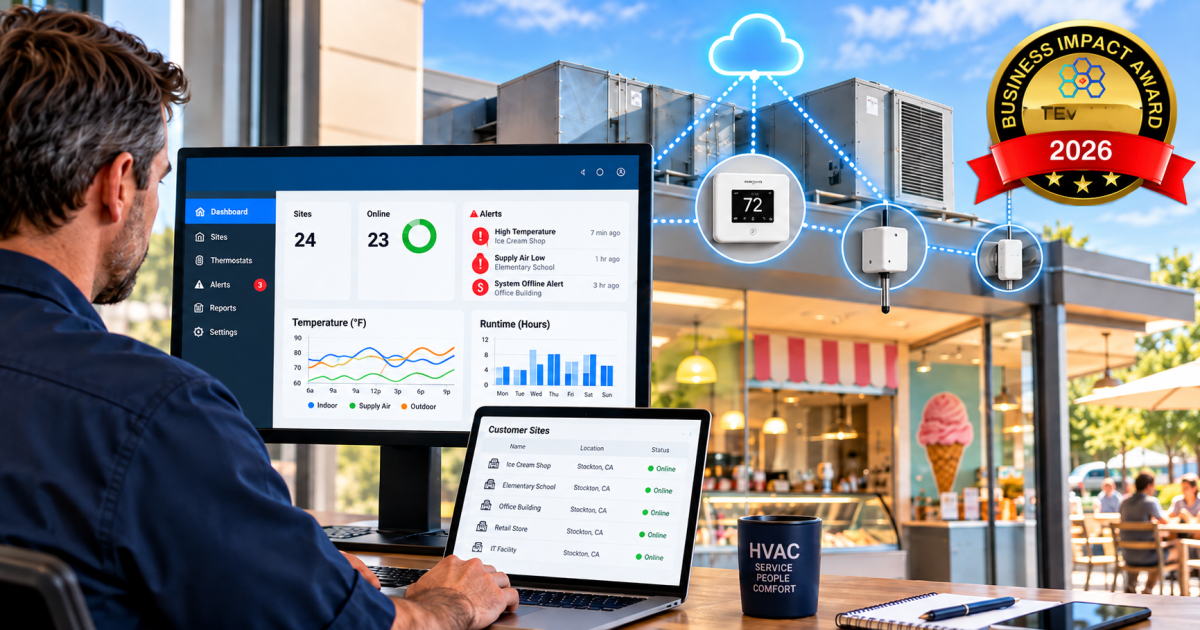
Venstar Skyport Cloud Services provided the connective layer. Skyport links compatible Wi-Fi thermostats to a secure private cloud and presents the portfolio through the SkyWeb interface or Skyport Mobile apps. Users can monitor and adjust systems, review one week of energy-use history, apply global changes across locations, and configure alerts for temperature limits, humidity, supply-air problems, external sensors, and service reminders.
Thermostats become field-service sensors
In the Queirolo’s deployment model, Venstar ColorTouch and Explorer Wi-Fi thermostats report through Skyport Cloud. Return-duct, supply-air, and wireless temperature sensors add information about how the HVAC equipment is actually performing, not merely what temperature has been requested. Runtime graphs expose operating patterns, while cloud alerts notify the contractor when observed behavior indicates a fault.
The system’s value emerged in a real customer event. When an air conditioning unit failed at the local ice cream shop, Skyport alerted Queirolo’s immediately. The team repaired the unit before the shop owner noticed the failure, reducing the window in which inventory could have been placed at risk.
A larger installation at a local school shows the management model at portfolio scale. Queirolo’s deployed 90 Venstar Wi-Fi thermostats across classrooms, the kitchen, and gym, together with duct, supply-air, and Wi-Fi sensors. Skyport lets the contractor and authorized users monitor comfort and energy use remotely. A four-hour cap on override mode also limits the duration of manual changes that could otherwise waste energy.
Skyport’s Sharing Center supports role-based access, while global controls help multi-location operators work from a common set of screens. For sites requiring local automation, Venstar also offers a no-license-fee Local API that can connect thermostats with systems including Control4, RTI, Home Assistant, and CoolAutomation, with or without Skyport.
Observable operational impact
One of the most impactful pieces of evidence is that Queirolo’s can verify whether customer systems are working without making a service call, examine runtime data before dispatch, and arrive with better diagnostic context. Customers gain earlier notice of faults and a clearer view of equipment use.
“Having remote access to our customers’ Wi-Fi thermostats helps us make sure their HVAC is working correctly without making a service call,” said owner David Queirolo. He also noted that runtime graphs help the company educate customers about potential energy savings.
The commercial model lowers another barrier. Skyport is provided without a monthly subscription or setup fee with Venstar Wi-Fi thermostats, and Queirolo confirmed there was no charge for the app or service.
Why Skyport merits Business Impact recognition
Skyport turns a thermostat estate into a service intelligence network. The system gives contractors a way to shift from reactive break-fix work toward monitored maintenance, while giving customers earlier warning and remote control.
Venstar’s Business Impact Award recognition rests on that practical change in workflow. The architecture is straightforward, the field examples are concrete and the benefit does not depend on a fabricated savings percentage. By combining connected controls, equipment-side sensing, alerts and accessible fleet views, Skyport helps an HVAC dealer direct attention where it is needed and intervene before a small fault becomes a larger business problem.
Edited by
Erik Linask