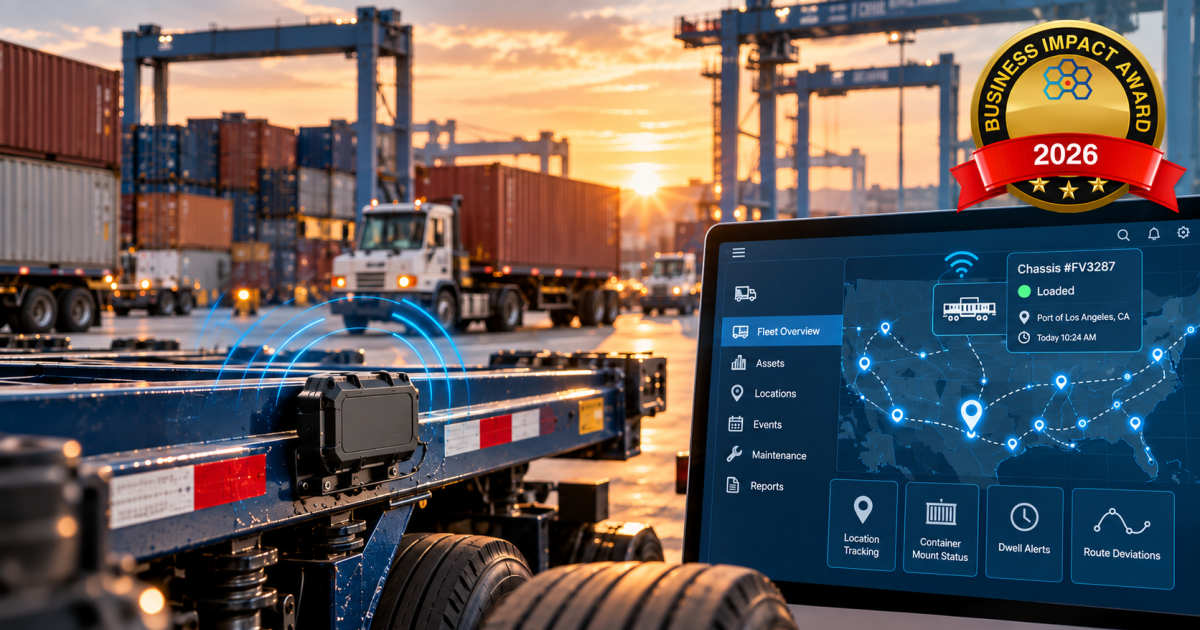
The unpowered-asset tracker feeds location, mount status and event data into a fleet platform built to coordinate intermodal operations at national scale.
The visibility gap beneath container logistics
Intermodal chassis are essential to moving containers among ports, rail terminals, distribution centers and customer facilities. Yet, they are unpowered assets, often dispersed across large yards and complex corridors. A dot on a map is useful, but operators also need to know whether a chassis is bare or carrying a container, how long it has remained in one place, and whether its movement matches the expected route.
FlexiVan Leasing set out to close those operational blind spots across a significant share of its nationwide SmartChassis fleet. The company wanted real-time location and movement updates, container mount status, dwell anomaly detection, route deviation alerts, and information that could support proactive maintenance. It selected Hoopo’s hoopoSense Titan and integrated its location-based data feed into FlexiVan’s AIM360 environment.
The deployment addresses a fundamental IoT question: how to make a large population of mobile assets observable when they do not supply their own power and regularly enter difficult radio environments.
Multi-modal sensing at the asset edge
Titan is a rugged, battery-operated tracker designed for chassis, trailers, and other unpowered equipment. It combines GNSS, Wi-Fi observation, Bluetooth Low Energy, and cellular communications, giving the device multiple ways to establish and report location. That mix is intended to preserve visibility in stacked yards and other signal-constrained settings where a single positioning method may struggle.
An integrated radar detects whether a container is mounted, while precision mount detection and continuous breadcrumb history add operational context. Hoopo’s machine learning rules engine classifies events, including container mounting, gate entry and exit, cross-border movement, and idle periods. The Titan carries an IP67 rating, offers a battery life of up to 10 years, and claims greater than 99 percent accuracy for location and event detection.
Installation is designed as a one-time, all-in-one deployment. Intelligent transmission policies conserve battery while maintaining updates, reducing the maintenance burden that can undermine a large tracker rollout. The FlexiVan implementation spans both direct-to-customer and pool-based operations, and its data serves the company’s Telematics, Maintenance, Business Intelligence, Commercial, and Loss Prevention teams.
AIM360 turns events into operating context
The device is only the edge of the architecture. Titan feeds into AIM360, FlexiVan’s platform for telematics, maintenance, billing and customer-facing analytics. There, location and event data can support dwell thresholds, route deviation alerts, maintenance triggers and tailored reports rather than remaining an isolated tracker stream.
FlexiVan’s broader data estate demonstrates the environment into which Titan is being integrated. The company says its SmartChassis fleet has surpassed 75,000 units and names Hoopo alongside BlackBerry Radar as a GPS and telematics partner. Its GPS-agnostic platform uses nearly 8,000 geofenced intermodal facilities and processes more than half-a -billion chassis and shipment data events annually.
That scale makes interoperability consequential. AIM360 can ingest feeds from different GPS providers, allowing FlexiVan to integrate Titan’s mount and movement intelligence into established workflows rather than create a separate operational island.
Don Alfarone, FlexiVan’s vice president of technical services, described the goal as enabling intelligence rather than simply capturing location. He said the technology supports tasks such as optimizing routing, identifying stalled assets and proactively scheduling field repairs.
Why Titan merits Business Impact recognition
The verified impact is capability and operating reach: a large segment of a national fleet is being equipped, data is integrated with AIM360, and multiple business teams can act on location, mount status, and classified events.
That is a credible basis for Hoopo’s Business Impact Award recognition. Titan addresses the physical constraints of unpowered intermodal assets with long-life, multi-modal hardware, then connects that edge intelligence to a platform already handling maintenance, billing and customer analytics. The result is not just another moving map. It is an operational data layer capable of flagging stalled equipment, abnormal dwell, route deviations and maintenance needs.
For an industry whose performance depends on asset availability and faster turns, making chassis legible to both people and systems is a meaningful advance. The FlexiVan deployment shows how IoT creates value when sensing, integration and workflow design are treated as one system.
Edited by
Erik Linask